Rosetta@home

About the price of oil

  UW Seal
 
[ Home ] [ Join ] [ About ] [ Participants ] [ Community ] [ Statistics ]
  [ login/out ]


Advanced search
Message boards : Cafe Rosetta : About the price of oil

Sort
AuthorMessage
Dimitris Hatzopoulos Profile

Joined: Jan 5 06
Posts: 336
ID: 47478
Credit: 80,939
RAC: 0
Message 17630 - Posted 5 Jun 2006 0:30:02 UTC
Last modified: 5 Jun 2006 1:27:53 UTC

Allow me to make an exception from the "light" subjects which ought to be discussed in a Cafe and talk a bit about the single most talked about subject of our days, the one of the oil price, on which I read a lot of misinformation.

Without going into technical details of how financial markets (where I'm an active participant for many years) work, I'll just share my firm belief that the current oil prices (late Sunday pre-market trading $73.25 at NY as I write these lines) is a huge, giant con-job, going on for several years now.

Despite what the Media (of mass deception, as I always call them) would want you to believe, this is not an issue of supply/demand at the physical market, but PRIMARILY a financial phenomenon.

For the past few years, untold billions are flowing into long-only commodity funds, which invest in the derivatives markets.
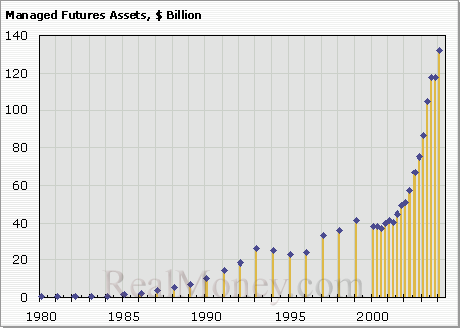

(btw, this is just the chart of the assets under management of commodity funds, which doesn't include big players like hedge funds nor prop trading desks of the big investment banks and other players)

The reasons for money flowing into commodities (as an asset class) are pretty obvious:

1/ to escape ongoing fiat currency (USD, EUR, Yen etc) depreciation (the same reason why gold/silver etc went sky high)
2/ to front-run growing countries' needs China/India/etc (buy today what China will want to buy tomorrow)
3/ "liquidity" (due to cheap borrowing rates and money printing) sloshing in the system
4/ and to follow the trend.

In protecting savings, oil and base metals like copper may be better alternatives than gold, because of the almost price insensitive, inelastic demand (you *will* find someone to buy it from you), let alone tax treatment.

It's all happening at the futures markets of NYMEX and IPE, despite a GLUT of oil at the physical side. It has NOTHING, ZERO, NADA to do with current supply and demand issues. Oil still costs $1.5/bar to OPEC producers (and about $6/bar for non-OPEC producers), when it was sold for $5-$10/bar in 1999.

So, why wouldn't someone buy the extra 2M bar/day offered by OPEC and bring this market down? The problem is that due to how the oil contracts are defined, it's practically impossible to do any MEANINGFUL arbitrage, which would bring the two markets (futures and physical) back in sync for the current contracts.

The big trading houses (investment banks) are making $$$ like bandits (look at where most of the their revenues come from) and so do the oil companies and oil producing nations. Even "investors" in oil make money, but only as long as this price rises, because they're charged huge "carrying costs". BUT, almost everyone else is getting scr*wed.

Politically speaking, I think "investors" (mostly westerners) are shooting themselves in the foot. The windfall profits made by oil producing nations mean that in the next few years, will not only result in Arab states record buying of e.g. Boeing planes (as has been the case sofar) but more of "XYZ (e.g. UAE) Investment Authority" buying toll roads, ports, companies etc in US, EU etc.

Overall, IMO, the lack of action by Western leadership against this is nothing short of criminal.

Ofcourse I wouldn't expect any better from people who are having their country mortgage its future (borrowing from the future) to fund its overconsumption today. What Buffet called "sharecropper society" a year ago.

Ordinary people have faith that their government is doing the best for them and that the media is actually informing them. If all you hear from the media (which IMO are just shills for those making $$$ from this) is that oil is going up because the world is running out of oil, or because China etc is using so much, then you accept $70+/bar oil like a "natural disaster".

The truth is:

1/ commercial (oil co) stockpiles are at the highest levels in 6+ yr (ever?) of >350Million bar:


2/ US Strategic oil reserve (SPR) have been filled up 100% between 2002 and Aug-2005, for >700Mbar, (a questionable move, which many think contributed to oil price spike). Before, the SPR was being slowly filled by the US govs since the 1980s.

3/ The physical ("wet barrel") market is well supplied. In fact, physical world oil demand is flat to down. OPEC has been saying for YEARS that REAL, PHYSICAL demand is NOT there and e.g. nobody took up the extra 2Mbar/day capacity offered after 4Q2005 (Katrina). OPEC: Is world running out of oil?

As per recent 4-May-06 testimony by Yergin in US Congress world oil demand was up only 1% in 2005 (source). China said that since 2004 it's going to rely on domestic supplies for most of its energy needs. By China's own announcements are that it's oil demand in 2005 is actually LOWER than 2004:

"The National Development and Reform Commission said recently that China's dependence on oil imports was 42.9 per cent in 2005, 2.2 percentage points lower than in 2004. It also said China consumed 318 million tons of oil last year, 1.08 million tons less than in 2004."
source


4/ All extra "demand" is happening in the futures derivatives markets. All "demand" is just what OPEC calls "paper barrels", with open contracts just in NY futures market being >1.6 BILLION "paper" barrels. This, on its own, is NOT wrong or bad etc (although authorities have been known to curtail such activities under extreme situations, like 1987 stock crash or 1980 silver short squeeze spike). But the problem of the past several years is an issue of too much money flowing into oil futures and inability to do arb between futures and physical. For some background on oil markets and the influence of futures read Oil Markets and Prices

So, from the lack of real action for 3+ years now, I can only conclude there is some hidden agenda behind accepting the broken price discovery mechanism in oil market today and that despite what they claim in public, the people in charge are happy with the rigging of oil price and its consequences.

My 2 cents for anyone who wonders.

____________
Best UFO Resources
Wikipedia R@h
How-To: Join Distributed Computing projects that benefit humanity

tralala

Joined: Apr 8 06
Posts: 376
ID: 73828
Credit: 581,806
RAC: 1
Message 17670 - Posted 5 Jun 2006 14:09:53 UTC - in response to Message ID 17630.

Interesting read, thank you! Although I studied economics the mechanics of stock exchanges still remain a mystery for me. I know it's all about perception and expectations but that does not make it easier to understand.

There is one upside on the current price surge: It increases energy costs thus creating an incentive to reduce energy consumption. If we want to keep the global warming under control we must reduce CO2 emmissions. Higher prices can only help achieving this (though higher prices especially hurt developing countries which is not good).
____________

Jomar

Joined: Jun 6 06
Posts: 1
ID: 91320
Credit: 20,075
RAC: 0
Message 17903 - Posted 7 Jun 2006 8:11:38 UTC

Very interesting. Thank you. Even though I am not that affected by gas price, I work in Saudi Arabia, my home country is definitely suffering from this "greedy" oil price maneuvers.

Any hope? What do you think?
____________

Robinski

Joined: Mar 7 06
Posts: 51
ID: 64155
Credit: 45,396
RAC: 0
Message 17908 - Posted 7 Jun 2006 8:47:42 UTC
Last modified: 7 Jun 2006 9:18:44 UTC

I think we need to abandon oil and move on to something else like Hydrogen as oil fields get depleted and it is bad for CO2 emmissions.

Here in Holland one would pay about 1,409 for a Liter of Benzine, this is way more then a few years ago. Prices are just Skyrocketing.

The best thing is to move to another type of fuel.

[EDIT]
And they just increased the prices again. the 1,409 was what I payed at the pump.
The advice price from one of the Oil company's nos even is 1,495, thats almost 1,5!!! for a Litle of Benzine.
____________
Member of the Dutch Power Cows

Trying to get the world on IPv6, do you have it? check here: IPv6.RHarmsen.nl

Dimitris Hatzopoulos Profile

Joined: Jan 5 06
Posts: 336
ID: 47478
Credit: 80,939
RAC: 0
Message 18017 - Posted 7 Jun 2006 22:18:41 UTC

Sure, we eventually need to diversify energy sources away from oil, but my point is that was is referred to as "shortage in the oil market" and subsequent runup in prices to historical highs of $70+/bar (where oil price has been for the past 1+ month) is just a financial phenomenon.

OPEC has been stating that they lost control since Y2000:

Friday, 22 September, 2000, 09:13 GMT 10:13 UK
Oil: New rules of the trading game
Market speculators using sophisticated financial instruments are having an increasing influence on oil prices.

The secretary general of the Organisation of Petroleum Exporting Countries (Opec), Rilwanu Lukman, says the world oil market is held captive by the derivatives markets. The old rules of supply and demand have been distorted, he says, by the creation of what he calls "paper barrels" of oil.

Opec president Ali Rodriguez says that at least $8 of the oil price is due to speculation.

They are both articulating the anxiety at the loss of control felt by the Opec oil producers. They can no longer manipulate the market mechanisms that have made them lots of money recently, but which no longer respond to the old fashioned rules they prefer.

Thus, says Mr Lukman - and he should know - the time has long gone when the complex trading systems that are responsible for moving oil around the world from producer to consumer were only governed by the rules of supply and demand.

Mr Lukman was for many years Nigeria's oil minister and representative at Opec, and as one of the organisation's oldest hands, has watched the oil market closely for almost three decades.


Back in Sep-2005, after the Katrina disaster and spike in oil price, OPEC offered an extra 2 Mbar/day of spare capacity ("as a symbolic move", because OPEC always stated that the physical market remained very well supplied), an offer which had no takers:

OPEC Offers an Extra 2M Barrels of Oil
2005-09-21 11:18:40 AP
Ministers of the OPEC agreed here on Tuesday to provide an extra two million barrels of crude oil a day in a bid to calm down the world oil market.

VIENNA, Austria-OPEC offered world markets an extra 2 million barrels of oil a day its entire spare capacity on Tuesday in an attempt to show that supply fears were unfounded even with traders eyeing another hurricane approaching the Gulf of Mexico.

The cartel, which has come under international pressure over the near-record prices that followed Hurricane Katrina, said its output ceiling would remain at 28 million barrels a day and stressed that the main obstacle is refining capability, not a shortage of crude.

"If you have a buyer, bring him, we'll give him the 2 million. We have the availability to provide it," said OPEC President Sheik Ahmed Fahd Al Ahmed Al Sabah, who is also Kuwait's oil minister.


Even more recently, Saudi Arabia cut its production, because physical (for "wet barrels") demand from refineries fell. While real demand fell, oil price spiked to new historical nominal highs of >$70/bar during the last few months:

Saudi ups prices, cuts output
Saudi Arabia: Tuesday, June 06 - 2006 at 08:31
Saudi has raised the official selling price for its crude oil to Europe in July, but cut prices to US buyers, according to Reuters. It increased prices to Europe by between 45 and 75 cents a barrel, while cutting US prices by 30 to 35 cents. Meanwhile, the world's top exporter cut production to 9.1m bpd in April, due to a drop in refinery demand, The Wall Street Journal quoted Oil Minister Ali Al Naimi as saying.

____________
Best UFO Resources
Wikipedia R@h
How-To: Join Distributed Computing projects that benefit humanity

Dimitris Hatzopoulos Profile

Joined: Jan 5 06
Posts: 336
ID: 47478
Credit: 80,939
RAC: 0
Message 18018 - Posted 7 Jun 2006 22:18:58 UTC
Last modified: 7 Jun 2006 22:53:34 UTC

There are others who agree that the oil price runup is a financial phenomenon.

One of them is Andy Xie, chief economist at MorganStanley for Asia-Pacific, who predicted a drop back in Jun-2005 (a year ago), citing the same fundamentals (still applicable) i.e. flat/down physical demand, ample supply of "wet barrels" etc.

In the one year that has passed, the "detachment" between the physical oil market fundamentals and oil's price has become even more extreme (because of the reasons I explained in my first post, basically lots of money flowing into the oil derivatives and no arbitrage between "wet barrels" and "paper barrels"):

http://www.morganstanley.com/GEFdata/digests/20050616-thu.html


Asia/Pacific: Scary Oil

Andy Xie (Hong Kong)

Chinas oil imports declined by 1.2% YoY in the first five months of 2005. US oil inventory increased by 6.4% in the first quarter of 2005. However, oil prices averaged 46% higher in these five months of the year and 50% higher in the first quarter, on a YoY basis. How to bridge the gap between rising prices and weakening demand? The answer, I believe, is that there are too many oil traders engaging in oil price speculation. They will likely keep prices up until an oil market collapse. That day is not too far away, I believe.

...

The hype over endless energy demand from China and India has triggered a massive boom in investment in this sector. As energy producers step up production from alternative energy sources (e.g., natural gas, tar sands, and coal gasification), oil prices could stay depressed for many years when the current economic cycle turns down. There appear to be many substitutes for oil at a cost equivalent to US$20/barrel. I think oil may experience a prolonged bear market in the next few years.

Oil Demand Is Weakening

Economic overheating, primarily in China, has exaggerated energy demand in the past three years. BP estimates that total demand for energy grew by 4.3% in 2004, 3.3% in 2003, and 3.4% in 2002, compared with annual growth of 1.2% between 1991 and 2001 and 2.1% between 1981 and 1991. China accounted for 52% of this growth between 2001 and 2004. Global energy demand ex-China grew by 1.9% between 2001 and 2004, versus annual growth of 1.1% between 1991 and 2001 and 1.7% between 1981 and 1991.

The booming demand for oil tells a similar story. According to BP, global oil demand grew by 1.9% per annum between 2001 and 2004 compared with 1.4% between 1991 and 2001 and 1% between 1981 and 1991. China accounted for 37% of global demand growth between 2001 and 2004, compared with 26% between 1991 and 2001.

There is little doubt that the current energy boom has been driven by China. As regards the sustainability of global energy prices, the key question is whether Chinas increased demand reflects a secular change or just cyclical overheating. I believe the latter to be the case. Chinas oil demand grew by 15.8% in 2004, versus 7.7% in 2003, 6.9% in 2002, and 7.6% per annum between 1991 and 2001. Last years extraordinary growth was distorted by Chinas electricity shortage. As Chinas electricity generation capacity catches up with demand this year, demand for oil should decline (see Oil vs. Coal, January 17, 2005). Despite a 16.3% increase of industrial production in the first five months of 2005, Chinas oil imports have declined this year.

I believe Chinas oil imports are likely to decline in 2005 and may fall further in 2006, as Chinas investment cycle turns down. The economic fundamentals for oil look very weak at present and into next year.

and Substitutes Are Coming

The high oil prices have triggered an investment boom in oil exploration and the production of substitutes. Oil sands, LNG, coal liquification and gasification are competitive against oil at US$20-25/bbl. As fixed investment piles into such alternatives, the energy supply curve has been permanently shifted outward, in my view. The current investment boom and the production capacity to follow may keep a lid on oil prices for many years to come.

Demand is also responding to high prices. Fuel-efficient vehicles are in vogue again. China is shifting its auto policy in favor of fuel-efficient cars. Manufacturing enterprises around the world are trying to increase energy efficiency in production. The Chinese government has instituted tax policies to discourage inefficient energy use by businesses.

Oil Prices Could Collapse Soon

Despite weakening demand, oil prices have kept rising this year. Dubai recently hit a historical high. The high prices will further weaken the main consuming economies, which are already slowing down, and demand for oil should weaken further.

Why are oil prices rising despite weakening demand and rising inventory? The weak dollar used to be a justification. But the dollar has rallied substantially in recent months.

I believe that a large number of financial institutions have become dependent on commodity trading (mainly, oil) for profits. The financial system suffers from overcapitalization. The pressure for increasing profits is intense. Oil has become the most important new source of profits. As oil has worked for so long, the financial community is hanging on to this position. Of course, when demand from financial investors is high, oil prices can remain high on self-fulfilling expectation.

What is occurring now is probably the final frenzy, in my view. The closing of the Brent / Dubai gap to the historical average would appear to be another sucking juice trade. Oil speculation last year was limited to light crude, such as West Texas or Brent. The gap between Brent and Dubai surged above US$12/barrel in late 2004, compared with an average of US$1.3/bbl between 1997 and 2001. The justification then was that there was a shortage of light crude. As soon as enough traders saw the wide gap, the juice was going to be squeezed out, either by pushing down Brent or pushing up Dubai. Since the market tone remained bullish, the latter was the natural choice and this is what has happened.

As evidence of weakening demand and ample supply accumulates, the market may panic. The oil market has been the most speculative in this cycle. I believe it could correct in the most speculative fashion it could collapse.

____________
Best UFO Resources
Wikipedia R@h
How-To: Join Distributed Computing projects that benefit humanity

Dimitris Hatzopoulos Profile

Joined: Jan 5 06
Posts: 336
ID: 47478
Credit: 80,939
RAC: 0
Message 18027 - Posted 7 Jun 2006 23:03:05 UTC
Last modified: 7 Jun 2006 23:18:02 UTC

Forbes seemed to think oil is a financial bubble too, back in Aug-05 (although Forbes talks about China, whereas looking closer you'll find that physical oil imports from Asia/China are flat/down in 2005 and 2006 sofar, as e.g. China has been developing domestic energy sources and transitioned to alternatives like coal):

Forbes: Oil Bust Will Dwarf Dot-Com; $35 Oil
Steve Forbes, editor-in-chief of Forbes magazine, predicts that skyrocketing oil prices are just temporary -- and a massive price collapse will dwarf the Dot-Com crash that began in 2000.

In Sydney, Australia this week for a global conference of CEOs, the respected financial editor said the that the price of oil has inflated into an unsustainable and speculative market bubble - and he says that when this bursts, it will make the Dot-Com crash "look like a picnic."

The paper quotes Forbes as saying that the price of oil (which rose above $70 this week) had been inflated by speculators and would soon begin a rapid slide.

"While there is a lot of talk in my country, the U.S., about the housing bubble, I think the real bubble, to be blunt, is in the price of oil," he said.

"It's a huge bubble. I don't know what's going to pop it, but eventually it will pop. The price has to be bought down to earth, and when it does there's going to be a lot of yelping from the hedge fund managers."

Forbes said that speculation on oil hitting $100 a barrel was misplaced.

"(But) if it does, the crash is going to be even more spectacular and will make the tech bubble look like a picnic," he said.

He also believes that the price of oil will decline significantly in 2006.

"I'll make a bold prediction: I think in 12 months, you're going to see oil down to $35, $40 a barrel," Forbes said. "In the meantime, it's a huge drain, more a psychological drain (on the economy), but it's not forever. This thing is not going to last."

Forbes blames the oil price spike on rising inflation and aggressive buying on the part of burgeoning Pacific Rim countries.

"China and India are buying more of the stuff. As the global economy expands, more energy will be consumed," he said.

"But if you look at the price of oil three years ago, it was $20 or $25 a barrel. Supply and demand might have shot it up to $30, $35 a barrel. The rest of it is inflation."

Forbes spoke to The Australian just as news was drifting in regarding the damage sustained to the oil-rich Gulf of Mexico in the wake of Hurricane Katrina. Industry observers say that energy companies such as BP, Chevron and Shell have been forced to shut down offshore platforms, which account for 25% of U.S. domestic oil and gas output.

____________
Best UFO Resources
Wikipedia R@h
How-To: Join Distributed Computing projects that benefit humanity

Charlie

Joined: Mar 25 06
Posts: 53
ID: 67848
Credit: 424,472
RAC: 0
Message 18333 - Posted 10 Jun 2006 3:44:31 UTC

This is a great post glad someone sees the truth about how the oil market works. Do we need to bring down CO2 emissions no doubt. IS global warming real doubt it. As 70 % of the so called scientist that proclaim global warming now 20 years ago were professing we were heading into a ice age. Tralala the high prices of oil wont force peopel out of thier cars. Look at how much it has cost in Europe for gas per litre for years they still drive just a little smarter than we do here in the USA.

Major problems for Global warming initutive is they do not treat each country the same. Just look at the Kayoto <Spelling> Accords What was call 1st world nations would have to drop back to late 70s emmissions thus destroying thier economies. While 2nd world nations would have to curb thier emmisions to date of signing, And lastly the 3rd world nations including china the largest expanding economy in the world would be allowed uncontrolled growth for a defined amount of years. This is more of 1 worldism controll than global warming controls


____________

Dimitris Hatzopoulos Profile

Joined: Jan 5 06
Posts: 336
ID: 47478
Credit: 80,939
RAC: 0
Message 18346 - Posted 10 Jun 2006 5:16:12 UTC - in response to Message ID 18344.
Last modified: 10 Jun 2006 5:16:34 UTC

Today I had some time to clean up the draft article parts posted here earlier and post it in my blog (in english):

http://dhatz.blogspot.com/2006/06/oil-to-38657-per-barrel.html

PS: I had to cut down some of the info I sent here in this thread, as the article otherwise would get too long. Feel free to copy it to people who might be interested.

PPS: In my blog, I also have commentary about outlook and my trades on various other markets (metals, stock indices etc), and ofcourse articles on inviting people to join humanitarian DC projects like Rosetta@home, but most articles are written in greek...

____________
Best UFO Resources
Wikipedia R@h
How-To: Join Distributed Computing projects that benefit humanity

Dimitris Hatzopoulos Profile

Joined: Jan 5 06
Posts: 336
ID: 47478
Credit: 80,939
RAC: 0
Message 18515 - Posted 12 Jun 2006 14:53:35 UTC - in response to Message ID 17908.
Last modified: 12 Jun 2006 14:56:18 UTC

I think we need to abandon oil and move on to something else like Hydrogen as oil fields get depleted and it is bad for CO2 emmissions.


My point was that until we move to hydrogen or antigravity or whatever, we shouldn't be accepting prices to be set by a broken oil pricing mechanism (as long as one agrees with the facts I've documented in previous posts - and the summary here)

Btw, substitutes currently used instead of oil (for economic reasons) are even more damaging to the environment, e.g. photos of Shanghai air pollution from Pearl Tower. You would think it was dusk, but not the case, 14:00 in the afternoon.


____________
Best UFO Resources
Wikipedia R@h
How-To: Join Distributed Computing projects that benefit humanity

Dimitris Hatzopoulos Profile

Joined: Jan 5 06
Posts: 336
ID: 47478
Credit: 80,939
RAC: 0
Message 18560 - Posted 13 Jun 2006 12:54:18 UTC
Last modified: 13 Jun 2006 13:14:52 UTC

Physical ("wet barrel") market is drowning in oil.

A few days ago (5-Jun-06), WSJ reported that the Oil Minister of Saudi Arabia said they had trouble finding buyers for crude oil and hence reduced production from 9.5Mbpd (where it stood for the past 2yr) to 9.1Mbpd:


In an interview after a meeting here of the Organization of Petroleum Exporting Countries, Ali Naimi said other cartel members are having trouble finding buyers for all the crude they are producing, at a time when global stores are near full and many refiners have closed facilities for routine maintenance. One Saudi official said an estimated three million barrels a day of refining capacity is out of action and unable to process crude, at a time when the world is using some 84 million barrels a day of oil products like gasoline and jet fuel.

"It's not just heavy oil. Even light oil is having problems" finding buyers, Mr. Naimi said, referring to premium grades of crude known as light crude that are highly prized by refiners because they have high gasoline yields.

Asked if the kingdom was easing up on supply because of concern about the buildup of inventories in the U.S. and other importing countries, Mr. Naimi rejected such a motive, replying: "At $70 a barrel?" Mr. Naimi suggested that producers will sell all the oil they can at such high prices.

The implication of Mr. Naimi's remarks is that Saudi Arabia would again open its oil spigots when buyers ask for more oil. For the past two years, the Saudis say, their policy has been to sell as much oil as buyers want, to the limit of the kingdom's production capacity.

____________
Best UFO Resources
Wikipedia R@h
How-To: Join Distributed Computing projects that benefit humanity

Dimitris Hatzopoulos Profile

Joined: Jan 5 06
Posts: 336
ID: 47478
Credit: 80,939
RAC: 0
Message 18825 - Posted 16 Jun 2006 21:25:24 UTC
Last modified: 16 Jun 2006 21:26:54 UTC

One more week ended with oil at $70/bar (it has "stabilised" at 70-75 for the past 2 months). I'm copying some comments from mainstream media, on the issue of speculation in oil. He makes a good point, that very often people discuss the irrelevant "fixes", not the problem.

Although, as I explained many times, the real problem isn't speculation (which is a useful transfer-of-risk service), but the FAULTY pricing system for oil which is being taken advantage of. So we have a situation where oil price goes up and up and at the same time oil producers can't find buyers for their oil (even light sweet crudes, just in case one wonders).

Recently (Apr-06) Saudi Arabia reduced production by -400,000 barrels/day (from 9.5Mbpd to 9.1Mbpd) because it could find no buyers for it.


The Danger of Speculation
Commentary by Mike Norman for FOX Fan Central

Mike Norman
It’s time to speak the truth. No more disingenuous questioning and wondering. No more exasperated resignation. We know the reason why oil prices are high, and it’s time to admit it and do something about it.

Oil prices are high because of speculation, pure and simple. That’s not an assertion, that’s a fact. Yet rather than attack the speculation and rid ourselves of the problem, we flail away at the symptoms. High gasoline prices? Oh, let’s use hybrid cars, or drill in the Rockies or off the California coast. How about doubling the use of ethanol, even though it costs more to produce than the energy you get out of it? Then again, we can go to Alaska, or build more refineries, or triple the number of nuclear power plants. Sound good?

What if we just stopped the speculation?

No, you can’t do that! That would be interfering with the “free” market.

Hey, the “free” market is starting to get awfully expensive.

Tell me, how is it free when speculators rule the roost? It’s one thing when they do what they do with pieces of paper called stocks, but it’s another when they do it with a vital commodity like oil. We saw the devastation their behavior wrought in the 1990s, and we’re witnessing it again right now.

rest of article: http://www.foxnews.com/story/0,2933,166038,00.html
____________
Best UFO Resources
Wikipedia R@h
How-To: Join Distributed Computing projects that benefit humanity

Dimitris Hatzopoulos Profile

Joined: Jan 5 06
Posts: 336
ID: 47478
Credit: 80,939
RAC: 0
Message 18944 - Posted 19 Jun 2006 18:55:39 UTC

I'll copy here some comments I made in reply of questions/comments posted in different forums:

--

To repeat the issue with broken arbitrage in oil:

If arbitrage in oil would work as in almost every other market, then I could e.g. buy those extra 400,000 barrels/day from Saudis (which recently cut, citing lack of buyers) at prevailing price $70 and immediately sell short 400 contracts at $70.

If I held my shorts to delivery (of physical), then the "investors" in oil would have to build storage tanks to accumulate the extra 400Kbpd, i.e. 12 million barrels per month. If I kept doing it for a few months, investors would have to keep building tanks to accept new oil or at some point choke on the supply of new oil and stop initiating new longs (buying new paper barrels of oil). Yet I would still be buying 400Kbpd from Saudis and selling short 400 contracts per day, which -in absence of "investor" buyers- would pressure the price down.

And when that happens, the "oil investors" would incur a big loss, because they'd have accumulated their hundreds of millions barrels inventory held in their tanks, at higher prices.

The abovementioned scenario ofcourse assumes REAL "wet barrel" oil demand is stable (e.g. China's oil imports were down -2.2% in 2005).

But, apparently it works differently for oil, because unless those 400Kbpd from Saudis are the exact type specified in the futures contract (as e.g. Brent is 0.4% of world's oil production, but is used to price 60% of world's oil), I can't do this kind of arbitrage at a scale that it would PROMPTLY affect price.

That's probably why oil price is going up while producers claim they can't find buyers for their real "wet barrels" of oil.


This "feeding of barrels" is happening and "investors" are hoarding it, which is why you see inventories rise, but it's an extremely slow process and meanwhile gullible consumer victims are forced to pay these obscene prices.
____________
Best UFO Resources
Wikipedia R@h
How-To: Join Distributed Computing projects that benefit humanity

Dimitris Hatzopoulos Profile

Joined: Jan 5 06
Posts: 336
ID: 47478
Credit: 80,939
RAC: 0
Message 18945 - Posted 19 Jun 2006 18:57:25 UTC

Much as one would like to blame the OPEC cartel, we can't ignore the fact that the markets that create this broken pricing system are in NY (NYMEX) and London. Just what else can the Arabs do, other than say "the market is oversupplied and over-priced" as they've been saying since 2005, or "find me a buyer and I'll give him 2 million barrels/day" ?

If the consuming nations want to break this vicious circle, there are several options, country-to-country contracts being one of them.

As for being a market bubble, I agree it is the case. But the issue here is that unlike a stock bubble, which one can simply ignore, we're all forced to be "long energy" and pay the price dictated by this broken pricing system! It's been THREE (3) YEARS of it already.
____________
Best UFO Resources
Wikipedia R@h
How-To: Join Distributed Computing projects that benefit humanity

Dimitris Hatzopoulos Profile

Joined: Jan 5 06
Posts: 336
ID: 47478
Credit: 80,939
RAC: 0
Message 19177 - Posted 23 Jun 2006 20:02:37 UTC

One more week gone by, with oil closing above the $70/bar price (it's been 2 months already). Doesn't make headlines anymore and people seem to be "accepting" it (?).

A poster at SETI's forum (here) asked me if I have an idea when the "bubble" will burst. I don't, primarily because I see incredible complacency by those being victimised (i.e. consumers) to the point I have to wonder about a hidden agenda (see my article on oil) and also because unlike stockmarket bubbles which deflate out of their own weight (nobody is obligated to buy a stock if he thinks it's overvalued), the KEY difference with a runup in vital commodities like energy is that there is almost inelastic, price-inensitive buying by the victims who need it.

The runup in price of commodities due to "investor" inflows is not limited to oil and it's (IMHO) NOT because everything is suddenly running out (peak XYZ). It's just that it's the one which most affects most westerners' everyday life. And because people notice the increase in its price (unlike many of the other commodities below).

For comparison, I'm attaching monthly charts of various commodities. You'll notice that those which enjoy almost inelastic, price-insensitive demand by consumer-victims held up their price quite well.

Oil:


Copper:


Platinum:


Gold/Silver


Orange Juice:


Sugar:

____________
Best UFO Resources
Wikipedia R@h
How-To: Join Distributed Computing projects that benefit humanity

Feet1st Profile
Avatar

Joined: Dec 30 05
Posts: 1725
ID: 44890
Credit: 843,377
RAC: 108
Message 19189 - Posted 23 Jun 2006 22:33:25 UTC

Dimitris, you seem to have a solid grasp of economics. Have you studied the effect of oil price on the other commodities? I mean if price of oil goes up, it will cost more to run a tractor across a field and harvest sugar cane, or cotton or oranges... and electricity costs will increase which has a great impact on smelting of metals, precious or otherwise. I mean how much of the increase in the prices of these other commodities is directly attributable to the increase in oil prices?
____________
If having a DC project with BOINC is of interest to you, with volunteer or cloud computing resources, but have no time for the BOINC learning curve,
use a hosting service that understands BOINC projects: http://DeepSci.com

Dimitris Hatzopoulos Profile

Joined: Jan 5 06
Posts: 336
ID: 47478
Credit: 80,939
RAC: 0
Message 19238 - Posted 24 Jun 2006 20:26:11 UTC - in response to Message ID 19189.
Last modified: 24 Jun 2006 20:52:02 UTC

Have you studied the effect of oil price on the other commodities? I mean if price of oil goes up, it will cost more to run a tractor across a field and harvest sugar cane, or cotton or oranges... and electricity costs will increase which has a great impact on smelting of metals, precious or otherwise. I mean how much of the increase in the prices of these other commodities is directly attributable to the increase in oil prices?


This is a very good question and it sounds logical.

In my opinion (being a participant in the markets for many years) is that it's primarily a FINANCIAL phenomenon, initiated by the tsunami of paper money and credit, unleashed by the world's central banks, starting back in 2002. Basically it's been just monetary inflation via an explosion of paper money and credit. Official reported inflation was masked mostly by changes in the CPI (if CPI were calculated as in 1980s, inflation would stand at 8% yoy) but also in part by the deflationary forces of globalisation.

In the process, we experienced a "Flucht in die Sachwerte" by more savvy investors.

Now, to answer your question about whether energy costs cause the price of other goods to rise, I'll send some more charts of commodities, which attempted to rally along with the rest but couldn't hold those gains:


So WHY do some commodities rally but others not e.g. cotton or corn or wheat or coffee? By now you'll probably have put the pieces in the puzzle, by noticing that the commodities which enjoyed big price increases (and held onto those price gains) were the ones which are either STORABLE (base and precious metals) or had a BROKEN price discovery mechanism (as in my opinion has oil, with no link between futures and spot and priced off futures).

So, basically in all cases the rally in prices has been due to "investor" ("speculator") money inflows. Obviously for those commodities where storage is too cumbersome and/or rot/decay/decompose etc it didn't work so well.


Btw, orange juice is in fact "frozen concentrated orange juice", which is why it's storable and it worked.

Also, don't think that e.g. cocoa supply caught up with "demand" and brought the price down (you know, from the billionz of Chinese and Indians who suddenly found out the joys of drinking hot chocolate as the media of mass deception would say :-), because a cocoa-tree needs about 5yr to grow.

Finally, you'll also notice, that e.g. natural gas, which is FUNGIBLE for oil in many applications, has dropped quite a bit (-65%) since Dec-05, as storages are full and they have no room to put the extra production! Yet oil has held to its entire gains.


____________
Best UFO Resources
Wikipedia R@h
How-To: Join Distributed Computing projects that benefit humanity

Dimitris Hatzopoulos Profile

Joined: Jan 5 06
Posts: 336
ID: 47478
Credit: 80,939
RAC: 0
Message 19322 - Posted 26 Jun 2006 15:14:59 UTC

One more article on the same subject (less technical, as it's aimed at the general audience):

source


Interview: Oil Expert Explains What's Driving Record High Prices
By Jeffrey Donovan
Azerbaijan -- Caspian oil derricks, pollution
(AFP)
Oil prices have climbed steadily since 2004, and today they rose again to new record highs of more than $74 a barrel. What's driving prices -- and can they be brought back down? Government officials and oil executives from more than 65 nations will be asking those same questions when they gather in Qatar on April 22-23 at a meeting of the International Energy Forum. Among the factors driving prices up are fears over possible supply disruption in major oil-producing states such as Iran, Iraq, and Nigeria, where a rebel offensive has cut off one-quarter of output.

PRAGUE, April 20, 2006 (RFE/RL) -- RFE/RL spoke with Leo Drollas, the deputy director and chief economist of London's Center for Global Energy Studies.

RFE/RL: The price of oil continues to climb to record highs. Analysts say fears over the Iranian nuclear crisis is one of only several issues driving up prices. Iranian President Mahmud Ahmadinejad only strengthened those fears on April 19, when he said oil prices are still below their true levels. What's your take?

Leo Drollas: The first thing we must say is that these high prices are really paper prices, in a sense for paper oil, they're not the prompt market -- that is, for real wet barrels, as we call them. So they're obviously driven a lot by news and by sentiment, and they refer to oil that is bought and sold months ahead through paper contracts. And these prices move quite quickly on news, and the news is bad at the moment for oil because of the Iranian standoff, because of problems continuing in Nigeria, and many other factors in the market.

RFE/RL: So you're saying that, beyond fears over Iran or supply disruptions in Nigeria, the futures market is driving up prices?

Drollas: There's a lot of money that has come into the oil market over the last few years. The money that is now tracking commodity indices has increased from about $8 billion in 2001 to about $70 billion today. So we've got a huge influx of money into commodity-tracking indices, and a large part of those indices of course refer to oil. So we've got a lot of speculative money or hedge-fund money or other kinds of investors coming into oil, thinking they're on a roll now and that oil prices will forever increase. And in a sense, this tends to fulfill the prophecy, as long as the money keeps coming in.

RFE/RL: How does that drive prices, exactly?

Drollas: What tends to happen is that the futures prices, especially for months further out, tend to rise, and they create a difference between future prices for outer months and spot prices for oil, especially for "wet" barrels. And this differential encourages people to buy physical oil, and therefore, the pressure from the futures market is transmitted to the actual spot market for oil.

RFE/RL: But isn't capacity part of the problem as well, both in terms of the actual supply of oil and the fact that, particularly in the United States, refining capacity is down, with some refining facilities still not fully recovered from last summer's Hurricane Katrina?

Drollas: Well, this is the huge, unanswerable question as to what component of this price run-up is due to speculation, as we call it, or due to real fundamental factors. My own gut feeling is that maybe $15 [per barrel] or so at the moment is due to these kind of pressures from the futures market, from speculation if you like. In other words, the price should have been quite a bit lower than that, because there isn't actually a physical shortage of oil at this very moment.

RFE/RL: So this gets us back, perhaps, to emotions -- to fears over possible supply disruptions due to crises in key producing countries, such as Iran, Nigeria, Iraq.

Drollas: Of course, the fear is there because of these factors: Iran and Nigeria in particular, and also Venezuela to some extent in the background. But one must bear in mind that there is a physical problem too, in the sense that the spare capacity to produce crude oil in the world is under 3 percent of global demand for oil. And a business that runs with such little spare capacity is vulnerable to all kinds of events that make people worry or fear whether the system is able to cope with the pressures that are put on it in, let's say, the autumn or the winter that we have ahead of us.

rest of interview in the link above
____________
Best UFO Resources
Wikipedia R@h
How-To: Join Distributed Computing projects that benefit humanity

Dimitris Hatzopoulos Profile

Joined: Jan 5 06
Posts: 336
ID: 47478
Credit: 80,939
RAC: 0
Message 19366 - Posted 27 Jun 2006 18:26:36 UTC
Last modified: 27 Jun 2006 18:29:45 UTC

More stuff posted in the mainstream media about this. Basically, I think everyone who has done his homework knows the oil price spike is due to "investor" demand.

As long as -due to small spare world production capacity for THOSE PARTICULAR CRUDE OIL TYPES- investors control the "marginal barrels" of the oil type used for physical delivery in futures (light sweet crude), they can set price to just about anywhere.

The question is whether something ought to be done about this bleeding of ~$500-$600bn/year from western nations into the hands of oil producers (at current prices it's going to be even more).

Bhushan Bahree and Ann Davis wrote in WallStreetJournal in Apr-06 (source):


Crude oil closed above $70 a barrel for the first time, highlighting a phenomenon reshaping the petroleum world: investment flows into oil futures are supplanting nitty-gritty supply-and-demand data as prime drivers of prices

In contrast to past bull markets in crude, this year's run-up has occurred even though oil inventories in the U.S., the world's largest market, have swelled to their highest levels in nearly eight years....

The answer to the puzzle posed by rising prices and inventories, industry analysts say, lies not only in supply constraints such as the war in Iraq and civil unrest in Nigeria and the broad upswing in demand caused by the industrialization of China and India. Increasingly, they say, prices also are being guided by a continuing rush of investor funds into oil markets. Institutional money managers are holding between $100 billion and $120 billion in commodities investments, at least double the amount three years ago and up from $6 billion in 1999, says Barclays Capital, the securities unit of Barclays PLC....

Since early 2005, the crude-oil market is in what traders call contango, meaning futures contracts for a given product are priced higher than that same good for near-term delivery. The price of oil to be delivered four months from now is about $3 more than oil to be delivered next month.
Flooded oil storage near Port Arthur, Texas
oil_storage2.jpg

In short, it pays for refiners and other oil-market players to buy and hold oil now to sell it down the road. Making that trading opportunity possible, says Colorado-based oil analyst Philip K. Verleger, is the huge volume of new buyers on the other side: investors who he estimates have put more than $60 billion into U.S. crude-oil futures since 2004.

Indeed, San Antonio-based Valero has been operating with its crude tanks full since the start of the year. When the market is in contango, "you tend to operate at the top of your tanks," says Bob Beadle, Valero's senior vice president in charge of crude oil, supply and trading. Mr. Beadle estimates that in the U.S., the difference between the industry operating at full tanks and at minimum operating levels amounts to as much as 75 million barrels of oil, or about three days of supply.

____________
Best UFO Resources
Wikipedia R@h
How-To: Join Distributed Computing projects that benefit humanity

Studer SL

Joined: Jun 6 06
Posts: 28
ID: 91171
Credit: 11,166
RAC: 0
Message 19380 - Posted 27 Jun 2006 22:01:59 UTC

What can be done?

There's tons of explanations of why the price is so high and won't come down. Listening to the radio, or reading the paper, I gather that the 'glut' of storage oil on the market has now affected OPEC so badly that they're storing oil in old tankers (and running out of them!). They're looking (begging) for people on the open (spot) market to buy oil. Inflation, inflation everywhere!

Pretty soon, the producers are going to have to start ramping back, correct? And when that happens, the price IS gonna be pretty much set in stone, correct?

Most of the charts and articles you've referenced here reflect the month of April, and they mostly talk about the Western world (specifically the US). What's going on in China? And to a lesser extent, India? Things haven't changed much in three months. It's such a fast changing world, too.

Interesting conclusion about the price of 'storable' commoditites. In fact, things like copper, gold, and silver are smelted. That is done in electric furnaces (they get their power off the grid). Most power plants are coal fired, or nuclear, or to a lesser degree natural gas, and although there has been a recent spate of accidents reflecting the recent 'renewal' of coal mining (the old plants will be getting older yet), and the nuke boys have been warming up their throats in congress (they still can't figure out what to do with the radioactive waste they generated from the first plant they built), I just don't see the correlation. All commodities have to be shipped from the point of origin to the point of sale, some may have more stops along the way, but food will always be more valuable than gold when push comes to shove.

I'm not an economist, but I would say those "orange" people have something to do with whats going on, too! Maybe these 'speculators' ain't so happy that the world is going flat without them?

This is my perception, (remember, I'm not an economist, but it doesn't take one to manipulate a market, just a bunch of willing/gullible people). If the price of gas is 1.50 a gallon US, is there enough incentive to invest/produce hydrogen fueled cars that require not only a major combustion engine modification but also a brandy new distribution system? Ethanol requires refining, and you can't do it in conventional refineries (and you're messin' with people's food supply too). Sunshine is expensive to convert into motive force (it has been said that a solar panel at todays efficiency never really ever pays for itself). Oil is an already existing commodity, controlled by a bunch of people we don't/won't trust. Maybe we do, or maybe we don't need new technology in those areas, but it has to be able to pay for itself.

Another interesting thing is that the European price for fuel has always been a lot higher than the US. I remember paying something like 4.50 a liter in Italy 10 years ago. Is that right?

What really bugs the heck out me is that I can buy gas at one station for 1.67 and across the street it's 1.73, or drive 20 miles to another town and pay 1.83 a gallon at the same brand name station that sells it for 1.67 in my town! Needless to say, the cars are always lined up at my gas station, I haven't seen any out-of-staters yet, but they are probably on the way!

So, my question is what mechanism could you use to artificially inflate the price of light sweet crude and sustain it, in order to develop new technology that will in the end, defeat it? And to further aggravate the question, who would be developing the new technology? Hate to be an outsider holding on to a bunch of light sweet crude when that happens, but either way, someone is always living behind a dumpster at a 7-Eleven.

I don't mean to minimize anything you've said or done here, like I said, I'm not an economist/investor and you are from the sounds of it. I do have these perceptions, and I've not heard a lot of talk about it except for the marketers trying to sell E85 cars, or hybrid cars, or fuel additives...... So please don't be offended if I sound radical, or way out in left field (I am an under-educated kook who can read). You've turned on a spotlight to the situation, I'd like to understand the mechanisms that can make it happen.


____________

Dimitris Hatzopoulos Profile

Joined: Jan 5 06
Posts: 336
ID: 47478
Credit: 80,939
RAC: 0
Message 19399 - Posted 28 Jun 2006 10:14:20 UTC - in response to Message ID 19380.

What can be done?


In my blog I offered several ideas:

"So, from the lack of real action for 3+ years now, e.g. no additions of refinery capacity for the heavier types of oil, or expanding the types of futures contracts traded, or adding risk to holding speculative longs by randomly selling e.g. 30Mb from SPR (instead of letting momentum funds front-run mindless price-insensitive buying for filling of US SPR during 2002-2005), or even suggesting that we go back to nation-to-nation contracts, I can only conclude there is some hidden agenda behind accepting the broken price discovery mechanism in oil market today"

There's tons of explanations of why the price is so high and won't come down. Listening to the radio, or reading the paper, I gather that the 'glut' of storage oil on the market has now affected OPEC so badly that they're storing oil in old tankers (and running out of them!). They're looking (begging) for people on the open (spot) market to buy oil.


Indeed, there is a glut of real "wet barrel" oil, yet price remains stratospheric at $72.2 a bit down from all-time-highs of $75. Basically IMHO it's a broken pricing mechanism, which leads to the paradox where oil keeps going up in price (supposedly on surging demand) and yet producers can't find buyers for REAL "wet barrels".

Inflation, inflation everywhere!


Inflation is evident everywhere but the governments' statistics and wages.

Pretty soon, the producers are going to have to start ramping back, correct? And when that happens, the price IS gonna be pretty much set in stone, correct?


The producers ARE cutting back, as they have nowhere to store it (why pump it up?). Wrt price, not really, it all depends on how long this broken system will persist.

Most of the charts and articles you've referenced here reflect the month of April, and they mostly talk about the Western world (specifically the US). What's going on in China? And to a lesser extent, India? Things haven't changed much in three months. It's such a fast changing world, too.


Charts are same-day as posts. Articles, I gather over the Web and may be weeks/months old. Doesn't change much, the real market picture is the same for the past 1.5yr

I'm not an economist, but I would say those "orange" people have something to do with whats going on, too! Maybe these 'speculators' ain't so happy that the world is going flat without them?


I'm afraid I don't understand what you mean "orange people"?

Another interesting thing is that the European price for fuel has always been a lot higher than the US. I remember paying something like 4.50 a liter in Italy 10 years ago. Is that right?


The difference in EU is due to taxes. I'm talking about CRUDE OIL in my articles, not the refined products (gasoline etc).

So, my question is what mechanism could you use to artificially inflate the price of light sweet crude and sustain it, in order to develop new technology that will in the end, defeat it? And to further aggravate the question, who would be developing the new technology? Hate to be an outsider holding on to a bunch of light sweet crude when that happens, but either way, someone is always living behind a dumpster at a 7-Eleven.


Well, one COULD use today's method, i.e. take advantage of the broken price discovery mechanism in crude oil to artificially inflate its price.

But it's like shooting oneself in the foot.

If governments want to reduce our exposure to foreign oil and/or go "greener" (more environment friendly), they can simply TAX the product. e.g. put a $3/gallon tax on gasoline to drive it to $6/gallon. It would force consumers to use less and opt for more efficient vehicles etc etc.

Instead nowadays it's ruining our trade balance. Because 500-600bn/yr goes to oil exporters.

It really makes no sense to me why this situation persists so long and why sheeple haven't revolted yet.

____________
Best UFO Resources
Wikipedia R@h
How-To: Join Distributed Computing projects that benefit humanity

Dimitris Hatzopoulos Profile

Joined: Jan 5 06
Posts: 336
ID: 47478
Credit: 80,939
RAC: 0
Message 19403 - Posted 28 Jun 2006 11:11:00 UTC
Last modified: 28 Jun 2006 11:43:39 UTC

Last week, Iran leased 2 more VLCCs (Very Large Crude Carriers, oil super-tanker ships)for oil storage, claiming lack of demand for heavy, sour crude. With now 9 vlccs, have storage capacity for 18.3 million barrels. (As per latest issue of OGJ.)

So, there is a GLUT of heavier crude oils, a GLUT of nat.gas (they couldn't find where to store it anymore and plunged in price -65% since Dec-05)

And the only "demand" is for light sweet crude oil via "paper barrels" of the futures markets (derivatives). As "traditionally" all crude oils are priced off those futures "paper barrels" benchmark, it causes the entire price chain to spike yet, despite the world being awsh in "wet barrels" of oil.
____________
Best UFO Resources
Wikipedia R@h
How-To: Join Distributed Computing projects that benefit humanity

Studer SL

Joined: Jun 6 06
Posts: 28
ID: 91171
Credit: 11,166
RAC: 0
Message 19580 - Posted 30 Jun 2006 15:12:39 UTC

To me building more storage is rather illogical. .... why pump something out of storage, so you can store it again, unless maybe you're going to refine it on the way? (on very large floating platforms no less, as if making and buying SUV's wasn't the epitomy of the supposed concensus on environmental issues) But then again, you can just 'drive' the refinery out of the path of a hurricane, eh?

About the 'orange' people. I've been reading a book called "The World is Flat" by Thomas Friedman. A little scary from an average, or below-average joe point of view. If Mexico can't compete with the Chinese, and we can't compete with the Indians, what do you think is going to happen to the standard of living in the US and other 'developed' countries? So, pick something that everyone is going to need and put your money in it, because a job is something you may not have next week, next month, or next year. Oil, oranges, and to some degree, brains. My vision of globalization and 'triple convergence' had a little something different in mind, but I guess it has to start somewhere.

What I'd like to see a litle more of is 'stewardship, spiritual wisdom, and leadership'. Pretty boring stuff, especially if it doesn't make money or better MY standard of living in some manner? It's why I like Rosetta.... My only wish (prayer) is that we were creating answers instead of possibilities. Why try to save lives in a life eat life world? Maybe that's why it doesn't fly in the face of some people's reality.

About increasing taxes to pay for new development. Governments increase taxes to support themselves. New technology development comes when those governments have some crisis on their hands and start losing points in the polls, then they hire private industry to 'fix it' for them. Creative people find creative ways to defeat those mechanisms too.
____________

Dimitris Hatzopoulos Profile

Joined: Jan 5 06
Posts: 336
ID: 47478
Credit: 80,939
RAC: 0
Message 19585 - Posted 30 Jun 2006 17:39:20 UTC

I'm copying over some discussions from SETI forums:

Um, I don't understand what you mean by the people should "revolt". Do you mean demonstrations at the refineries? Protests in the streets?


I'm not talking about refineries or BigOil. Ofcourse they're profiteering off a broken pricing mechanism and pretend all is well and are shedding crocodile tears about how sorry they are.

I mean to change the BROKEN mechanism used to set the price of oil, off the price of derivatives whereas there is no real link between derivatives and physical. Isn't it obvious?

When you have even the #1 exporter of oil in the world tell you BLUNTLY that oil should be selling for no more than $50 (see yesterday's Reuters story) and now it's 50% higher, just what more do people need?

If we were talking about the market for apples instead of oil barrels, and you saw the price go up and up and at the same time the producers tell you can't sell their apples, wouldn't you think the market is "broken"? Why don't people do the same for oil?

Apparently people have the misconception that international "open markets" set the price for oil, but due to technical aspects -explained earlier- the oil derivatives markets are neither free nor fair. They're cornered, but unlike a similar situation that might happen in a piece of paper i.e. stock, oil is a basic commodity which everyone HAS to buy and it's getting awfully expensive!


Um, I'm not disagreeing with you at all, Dmitri. <kindly said>

I'm just asking about the "How" of it all. What would you like people do to get this changed?

Best regards.


Edit: P.S. I'm seeing the price disconnect at the supermarket every day, on apples and other products. There's a complete disconnect there too. Prices are based solely on demand monitored in real time by the retailers' computers. Only a drop in demand succeeds in lowering prices. These new price disconnects we're seeing are a feature of new computer-enabled business savvy in many fields, I think.


____________
Best UFO Resources
Wikipedia R@h
How-To: Join Distributed Computing projects that benefit humanity

Dimitris Hatzopoulos Profile

Joined: Jan 5 06
Posts: 336
ID: 47478
Credit: 80,939
RAC: 0
Message 19587 - Posted 30 Jun 2006 17:42:47 UTC
Last modified: 30 Jun 2006 17:46:17 UTC

To answer Beethoven's question, What I would like people to do to get this chaged:

Write to your regulators / legislators / representatives. Surely there must still be a few honest men among them, who care for people's interests. They can't all of them have sold you out, can they?

Take the "investors" who are pouring $$$ in oil "paper barrels" out of the picture. Demand that anyone dealing in oil for over a certain threshold, must be involved in the physical market.

The price mechanism for oil is broken and the market is cornered. One way to immediately solve this crisis, is to abolish the current pricing system and go back to nation-to-nation contracts. If Saudis say they see no reason why oil should be trading over $50 (see statement 2 days ago), use that price as a start.

There are other options, I get more technical in the links:
http://dhatz.blogspot.com/2006/06/oil-to-38657-per-barrel.html
http://dhatz.blogspot.com/2006/06/oil-price-marginal-barrel.html

This IMHO is NOT a problem which can be solved by reducing demand/consumption or increasing supply (drive less, drill ANWAR) for PHYSICAL, real "wet barrels" of oil (unless we're talking adding 10Mbpd in spare capacity for LSC which can't happen overnight). There is ALREADY a enough real oil to meet demand, the producers can't find buyers for it (not just now, but for some time, S.A. cut -400Kbpd, Iran is leasing VLCCs to store it while looking for buyers). Producers are pumping LESS than what they did 1-2 years ago as they have no buyers, you read about it everyday and yet price is driven up at the "paper barrel" financial trading level.

Remember that the biggest part of US' trade deficit is due to oil imports. And you're paying for it by selling out your country's "silverware", i.e. selling toll-roads, ports, companies etc.

If it were a REAL supply/demand crisis situation, where countries were outbidding eachother for the last few drops of oil, it might have been a "necessary evil" to sell out your country's silverware to pay for it. But always remember that THERE ARE NO REAL BUYERS FOR PHYSICAL OIL IN THE REAL WORLD and this situation exists so that very few people can make even more obscene profits!


PS: As I'm writing this, oil is back near all time highs, over $74/barrel!

____________
Best UFO Resources
Wikipedia R@h
How-To: Join Distributed Computing projects that benefit humanity

Dimitris Hatzopoulos Profile

Joined: Jan 5 06
Posts: 336
ID: 47478
Credit: 80,939
RAC: 0
Message 19804 - Posted 5 Jul 2006 17:33:49 UTC

Just a quick note that crude oil is back at all-time highs of $75+/bar, rising +1.75% sofar today (session isn't over). Sofar, I don't see real outrage.

Meanwhile today, natural gas (which is substitutable for oil in many application) is at 2yr lows, down -4.5% today, down -65% from Dec-2005 and nat.gas trades right now at a price which would correspond to crude-oil $35/bar (instead of $75/bar).

The past weekend, Saudi Oil Minister gave an interview to a French newspaper, here's some extracts from Reuters story:

Naimi said Saudi Arabia had always worked on market stability "in the interest of consumer countries, producer states and in the interest of the world economy in general".

"There is no doubt that the initiatives taken by my country and by other oil producers, within or without OPEC, will sooner or later return stability to the market," Naimi said.

Naimi said since the beginning of his career in the oil sector, he had never seen as many disagreements and agitation, noting this could partially be explained by a short-term rise in oil prices and "rumours about an assumed exhaustion, limits in excess production capacities and effects on the environment".

"It is preferable to us, government officials, business men and intellectuals, to be realistic, to avoid resorting to intimidation or exaggeration despite what this might accomplish in terms of attention and short-term political advantages."

____________
Best UFO Resources
Wikipedia R@h
How-To: Join Distributed Computing projects that benefit humanity

Dimitris Hatzopoulos Profile

Joined: Jan 5 06
Posts: 336
ID: 47478
Credit: 80,939
RAC: 0
Message 19805 - Posted 5 Jul 2006 17:46:28 UTC
Last modified: 5 Jul 2006 18:13:28 UTC

Studer SL, you raised some interesting points, but I wanted to stay on the topic of oil in this thread. I'll be happy to discuss general economic matters and my outlook. (I'll only send URLs to sites with info I think is right)

I'll send a couple of charts here, but if people want to discuss economic matters, we'd better create a new thread for general economic/political issues (perhaps "vote" withthe +/- signs?)

Late credit card payments in USA, as proxy for "distress in the system":


Spending on essentials as % of disposable income:


Basically, watching the trends, it's easy to tell that US is rapidly destroying its middle class and ladders of upwards mobility. IMHO it's being done on purpose, but then I'm heavily biased aginst the current regime, so I may not be totally objective and you should look at the facts and make up your own mind.
____________
Best UFO Resources
Wikipedia R@h
How-To: Join Distributed Computing projects that benefit humanity

Dimitris Hatzopoulos Profile

Joined: Jan 5 06
Posts: 336
ID: 47478
Credit: 80,939
RAC: 0
Message 19807 - Posted 5 Jul 2006 22:32:24 UTC
Last modified: 5 Jul 2006 23:09:54 UTC

Just in case anybody missed it, today crude oil made new all-time highs (intraday) to $75.4/bar, up 1.8%

On the other hand, natural gas is down -6% today and down -65% since Dec-2005 just made fresh 1.5 YEAR LOWS. Nat.Gas also belongs to the energy complex and its price is historically correlated with crude oil (correspondingly to their respective energy content; a barrel of oil has about six times the energy content of a thousand cubic feet of natural gas). Although they're not perfect substitutes, they're used interchangeably esp. in industry.

In both cases of nat.gas and crude oil, the storage facilities are almost FULL and supply comfortably covers demand. In the case of nat.gas it pressures price downward, whereas oil -having IMO a BROKEN pricing system, as I've explained in detail earlier- price keeps going up and up due to financial inflows for "paper barrels", but producers like Saudi Arabia and Iran can't find buyers for their real "wet barrels" of oil.

And crude oil producers resort to actually cutting production e.g. Saudi Arabia cut production by -400,000 barrels/day (from the 9.5Mbpd level of the past 2yr downto 9.1Mbpd) in Apr-06 citing lack of buyers and Iran leased 2 more VLCC supertankers a few weeks ago, for a total of 9, to use them to store 18 million barrels while looking for buyers. (explained in detail and citing sources in prior posts)

Nat.Gas is now trading at a price equivalent to oil at $35/bar (instead of $75/bar it's right now)


____________
Best UFO Resources
Wikipedia R@h
How-To: Join Distributed Computing projects that benefit humanity

dgnuff Profile
Avatar

Joined: Nov 1 05
Posts: 336
ID: 8170
Credit: 7,643,647
RAC: 7,999
Message 19853 - Posted 6 Jul 2006 22:04:59 UTC - in response to Message ID 19480.


Feet1st, mentioning oil, you've struck a nerve.

I'll never understand people, why they don't REVOLT against this kind of abuse. After bleeding financially for years and years. How can they possibly believe people who are lying to them in the most blatant and obvious way?


You're expectng logical behaviour there. Which is NOT going to happen in a society that is told by adverisers that the cool vehicle they have to own burns about 80% of a pint of gas each mile it goes.

Hummer Fuel Stats

Look at the 2004 H2 SUV and weep.

Also, (to quote John Lennon) "You say you want a revolution ..." How exactly are we supposed to revolt?
____________

Dimitris Hatzopoulos Profile

Joined: Jan 5 06
Posts: 336
ID: 47478
Credit: 80,939
RAC: 0
Message 19881 - Posted 7 Jul 2006 13:00:05 UTC - in response to Message ID 19853.


Feet1st, mentioning oil, you've struck a nerve.

I'll never understand people, why they don't REVOLT against this kind of abuse. After bleeding financially for years and years. How can they possibly believe people who are lying to them in the most blatant and obvious way?


You're expectng logical behaviour there. Which is NOT going to happen in a society that is told by adverisers that the cool vehicle they have to own burns about 80% of a pint of gas each mile it goes.

Hummer Fuel Stats

Look at the 2004 H2 SUV and weep.

Also, (to quote John Lennon) "You say you want a revolution ..." How exactly are we supposed to revolt?


dgnuff, I understand what you mean about the Hummers and it's a sign of our times.

But what really bugs me is that this whole runup in oil price (which incidentally just made new all-time highs today to $75.775/barrel as I'm writing this) is basically a financial game which is now out-of-control.

I will stop here, because oil is not the subject of this thread.
____________
Best UFO Resources
Wikipedia R@h
How-To: Join Distributed Computing projects that benefit humanity

Studer SL

Joined: Jun 6 06
Posts: 28
ID: 91171
Credit: 11,166
RAC: 0
Message 19929 - Posted 8 Jul 2006 15:32:41 UTC

been poking around at the web on this subject some more. found a pretty interesting report from the EIA (energy information administration) about the price of gasoline. http://tonto.eia.doe.gov/oog/info/twip/twip.asp

Seems as though one of the real problems is refining.... US demand is so high, that European and other global refiners are now supplying either finished gasoline or blend stocks to the US at ever increasing levels. How can you have nation to nation contacts when the oil is being refined globally? Refiners buy and ship to their refineries to process into various products, and that depends on the bottom line and the availability of refineries. The excess in crude is probably also due to the decrease in import demand from China. Either the 'boom' years in China are coming to a close, or they've been able to increase their own capabilities enough to wean themselves from the global market somewhat.

I remember recently (about a month ago) a bill proposed in congress to streamline the permitting process for the construction of new refineries. Key items on the bill were: decrease the amount of time and money involved in the 'permiting process' from the current average of 10 years and 10's of millions to something like 18 months and single digit millions, and also decrease the amount of court time from NIMBY (not in my backyard) attitudes toward building more refineries by allowing the purchase or lease of land from the federal government (the proposal mostly pertainted to closed military bases and other federal lands that were being closed down or the functions drastically reduced. This bill included not only traditional oil refineries, but also alternative fuel refineries such as ethanol.

The bill was shot down. It was proposed by mostly republicans, and opposed by mostly democrats. Once you got past all the partisan politics, it was mostly due to concerns over the environmental impact and worries about allowing big business to 'cut corners'.

Its all a pretty big game to me. All this technology and we don't know how much oil we have left? We have to "estimate"? And furthermore divide it into 'quantifiable qualities' and then guess on that too? Reserves don't mean reserves... they mean 'profit' for speculators.. of which we all are in one way or anther.

I'd complain to my representatives, but they're as corrupt as big oil. Some of them ARE big oil! Anything that makes sense for the people would have laws made to prevent it.. And that's from both sides, and those who call themselves independents too.

Maybe oil is how the democrats are funding their election run in '08?
____________

Dimitris Hatzopoulos Profile

Joined: Jan 5 06
Posts: 336
ID: 47478
Credit: 80,939
RAC: 0
Message 20016 - Posted 10 Jul 2006 22:05:44 UTC
Last modified: 10 Jul 2006 22:36:06 UTC

StuderSL, Saudis also seem to think that refining is the problem:

PWR-SAUDI-SCPMA-OIL
Saudi Arabia attributes oil prices hike to lack of advanced refining capacities

RIYADH, July 2 (KUNA) -- Saudi Arabia attributed on Sunday the current hike in oil prices to the lack of advanced refining capacities, not shortage in supplies of crude oil.

According to Saudi Press Agency (SPA), Secretary-General of Saudi Arabia's Supreme Council for Petroleum and Mineral Affairs (SCPMA) Dr. Mutalib Al-Nafisa said the council held a meeting today that included reviewing the oil market's current status in light of the fluctuation in prices that do not serve oil producing or consuming nations.

The council expressed comfort with the current balance between supply and demand with the availability of surpluses that are the highest for quite few years, he added.

The meeting, headed by Saudi King Abdullah bin Abdul-Aziz, approved a national petroleum strategy for 2006 to ensure the market's stability on the short and long terms.

The strategy includes increasing Saudi Arabia's production capacity to meet anticipated international supply and demand, as well as boosting refining capacity by establishing refineries capable of refining heavy crude oils, boosting the oil market's transparency and encouraging the development of international oil industries. (end)


Now, I know that saying "crude is up because of refinery bottlenecks" sounds the same as saying "the price of wheat is up because of bakery problems/bottlenecks" because in fact a refinery bottleneck would increase the price of one type of e.g. light sweet crude and create a glut of another type e.g. heavy sour crude oil.

Which it has (created a glut of other types) so we read that SA, Iran etc can't find buyers for all their oil anymore. Btw that oil had real buyers in the past (which proves there's some demand destruction, due to high prices).

____________
Best UFO Resources
Wikipedia R@h
How-To: Join Distributed Computing projects that benefit humanity

Dimitris Hatzopoulos Profile

Joined: Jan 5 06
Posts: 336
ID: 47478
Credit: 80,939
RAC: 0
Message 20017 - Posted 10 Jul 2006 22:30:13 UTC
Last modified: 10 Jul 2006 22:33:56 UTC

Since there's so often misinformation, here are the latest numbers on crude oil inventories ("stockpiles" or "stocks"), at highest levels in over a decade (and 20yr highs for OECD countries). These are the "commercial" inventories at ~350million barrels, not counting the ~700 million barrels in US SPR (Strategic Petroleum Reserve).


combined with US SPR, they're at the highest level ever.

Also, much higher than "normal" levels for this time of year (from DoE website):

Crude oil inventories


And gasoline inventories


source: http://tonto.eia.doe.gov/oog/info/twip/twip_crude.html

IMHO this data is basically irrelevant, as the issue here is a cornered financial market, but just in case you want to watch the "funnymentals".
____________
Best UFO Resources
Wikipedia R@h
How-To: Join Distributed Computing projects that benefit humanity

Dimitris Hatzopoulos Profile

Joined: Jan 5 06
Posts: 336
ID: 47478
Credit: 80,939
RAC: 0
Message 20044 - Posted 11 Jul 2006 21:59:49 UTC
Last modified: 11 Jul 2006 22:56:40 UTC

I've tried to explain the crude oil pricing mechanism as best as I could and why I think it's broken. I'm not sure if I was able to make things clear enough.

A very good description of the flaws of the current pricing system of crude oil comes from Robert Mabro (a scholar and highly regarded consultant with 3+ decades of experience in the oil market, now retired). He explained the issues in his 2000 article:

http://www.oxfordenergy.org/comment.php?0008

which I think is a must-read for anyone who wants to understand the oil market (I've linked to it in the 1st post in this thread). Btw the situation back then (1998, 2000) was much less acute than today.

Here's an extract from the abovementioned article:

"As mentioned before, because of the lack of good information on production, stocks and demand, what rules the market is the consensus view about these numbers rather than the actual situation. This has an important implication for OPEC. When OPEC has to decide on a production policy in order to reverse a price fall as in 1998 and March 1999, it is obliged to reduce production by the volume demanded by traders and not by the amount required to restore the supply/demand balance. And the market has a tendency to believe in myths, such as the myth of the `missing barrels' in 1998. In that year OPEC, together with Mexico and Norway, reduced oil production twice (in March and June) to no avail. The oil price continued to fall. The market did not believe that the reductions were large enough. In March 1999 OPEC cut production by the large amount demanded by the market. This turned out to be too much as evidenced by the relentless price increase that followed throughout that year.

It is nice to say that markets should rule. The statement is however meaningless and indeed dangerous in its implications if one does not specify which market, and the conditions that qualify a market to rule. The oil futures markets as they exist today and for the reasons mentioned earlier on do not qualify. Yet, OPEC has to follow their whims to influence the course of oil prices and this seems to be an important cause of high volatility."


Mabro's CV, Awards (by OPEC, the Queen etc :-). He published several books and articles on the oil markets.

"In December 1991 Mr Mabro was awarded the International Association for Energy Economics 1990 Award for Outstanding Contributions to the Profession of Energy Economics and to its Literature.

In December 1995 he was awarded a CBE by HM the Queen in the New Year's Honours List. In 1997 the President of Mexico awarded him the medal of the Mexican Order of Aguila Azteca and in 2000 the President of Venezuela awarded the medal of Francisco Miranda, and in 2001 was promoted Officier des Palmes Academiques (France).

In 2004 he received the first OPEC award for contribution to oil studies."


PS: Mabro is retired. I don't know why more people in the oil industry don't speak up CLEARLY about this subject, considering the economic damage inflicted upon consuming nations ... (they do speak, e.g. Leo Drollas http://boinc.bakerlab.org/rosetta/forum_thread.php?id=1707#19322 but it's not always clear what the cause and effect is)
____________
Best UFO Resources
Wikipedia R@h
How-To: Join Distributed Computing projects that benefit humanity

dcdc Profile

Joined: Nov 3 05
Posts: 1212
ID: 8948
Credit: 4,132,445
RAC: 4,583
Message 20148 - Posted 13 Jul 2006 22:17:05 UTC

here in the Britain it recently hit £1/litre - currently about 97p/litre. I've seen a lot more dual fuel cars around recently!
____________

Dimitris Hatzopoulos Profile

Joined: Jan 5 06
Posts: 336
ID: 47478
Credit: 80,939
RAC: 0
Message 20185 - Posted 14 Jul 2006 15:36:44 UTC
Last modified: 14 Jul 2006 15:45:03 UTC

As crude oil price in NYMEX (New York Merc) Sep-06 traded over $80/barrel earlier today, which will cause more financial hardship to millions of people, you need to keep in mind that this entire "energy crisis" has been ENGINEERED, FABRICATED from A to Z in the derivatives markets of NY and London.

Here's something that I meant to send, but wanted to check archives to make sure it had actually been said (and was not some kind of "urban legend"):

‘‘Leon Hess, whose oil company made more than $200 million by trading oil futures during the Persian Gulf crisis ... said he longs for the days when oil company barons could get together and decide prices and supply levels largely among themselves, rather than depending on the violent price swings created by traders who react to rumors and headlines.
‘‘‘I’m an old man, but I’d bet my life that if the Merc [New York Mercantile Exchange] was not in operation there would be ample oil and reasonable prices all over the world, without this volatility,’ Hess said at a hearing the Senate Committee on Governmental Affairs held on the role of futures markets in oil pricing.’’ —‘‘Oil Baron Longs for Past, Not Futures,’’ Newsday, November 2, 1990


____________
Best UFO Resources
Wikipedia R@h
How-To: Join Distributed Computing projects that benefit humanity

Dimitris Hatzopoulos Profile

Joined: Jan 5 06
Posts: 336
ID: 47478
Credit: 80,939
RAC: 0
Message 34553 - Posted 11 Jan 2007 23:54:32 UTC
Last modified: 12 Jan 2007 0:11:12 UTC

Following up, the 14-Jul-2006 date of my previous post incidentally marked the high of crude oil and it has been falling since:


The primary reason for the drop isn't "warm weather" or "resolving of geopolitical tensions" etc, but like the uptrend again has to do with the players of the financial markets (investors), which exit their position once the trend changes.

In the previous months another trigger for the change in trend may also have had to do with GoldmanSachs (investment bank) re-balancing its GSCI commodity index (which is tracked by billions $$$ in "passive" commodity investment funds) which meant that they had to start "lighten up" investment position in the energy complex (much like when a stock enters/exits an index like Nasdaq100 or SP500, index tracking funds have to buy/sell it).

Coincidentally, the newly appointed US Treasury Secretary, Paulson, was the previous manager of GoldmanSachs (which runs this index) and they did the change a few months before the elections. A somewhat conspiratorial piece titled Friends in high places has more on this...

Right now the big fall in the last few days in 2007 is due to the quarterly redemptions of hedge funds (investors bail out), which in turn liquidate positions (i.e. sell "paper-oil" contracts).

PS: A similar situation as in oil above happened in nat.gas market in Sep-06 (due to the blow-up and forced liquidation of the Amaranth hedge fund which held big positions in nat.gas futures contracts) which drove natural gas price temporarily -50% (!!!) in a few weeks.
____________
Best UFO Resources
Wikipedia R@h
How-To: Join Distributed Computing projects that benefit humanity

Message boards : Cafe Rosetta : About the price of oil


Home | Join | About | Participants | Community | Statistics

Copyright © 2010 University of Washington

Last Modified: 3 Dec 2007 20:36:19 UTC
Back to top ^